
M2 interface (NGFF)
M.2 is interesting not just because it can speed up storage with PCI Express lanes, but because it can use a whole bunch of different buses too; it stands to replace both mSATA and mini PCI Express, two older standards that have been used for SSDs and Wi-Fi cards in laptops for a while now. Intel’s new Broadwell CPUs and their chipsets include native support for M.2 and PCI Express boot drivers—neither PCIe-connected storage (hi Apple) nor the M.2 connector itself are new, but beginning with Broadwell systems each of those two things will become much more common. - Understanding M.2
The M.2 standard is an improved revision of the mSATA connector design. It allows for more flexibility in the manufacturing of not only SSDs, Wi-Fi, Bluetooth, satellite navigation, near field communication (NFC), digital radio, Wireless Gigabit Alliance (WiGig), and wireless WAN (WWAN).
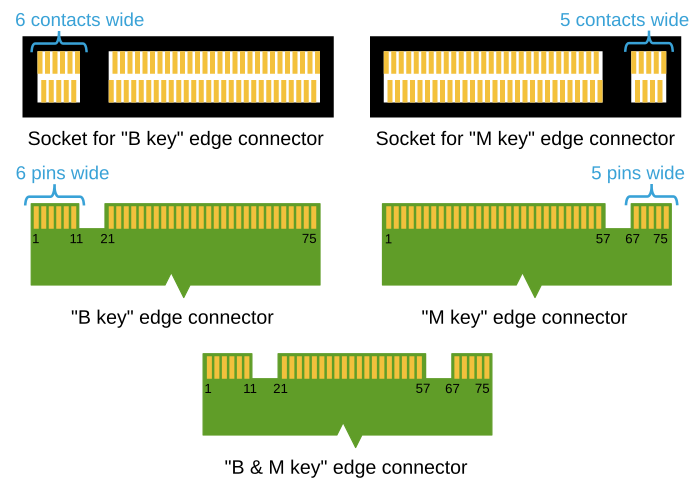
# key / type
- A - Wi-Fi/Bluetooth, cellular cards
- B - SATA and PCIe x2 SSDs
- E - Wi-Fi/Bluetooth, cellular cards
- M - PCIe x4 SSDs
# SSD type
not to be confonded with

see also